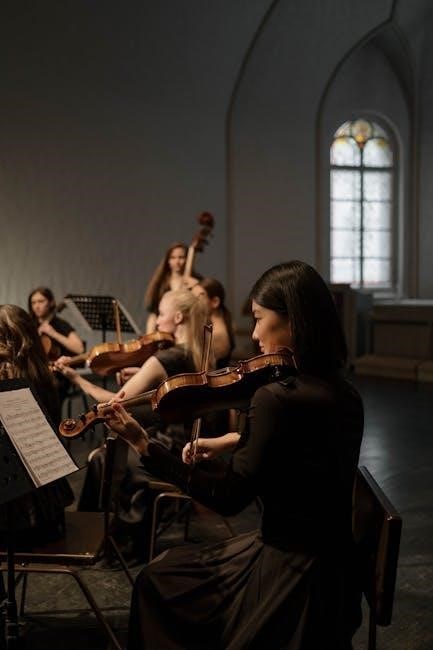
Jesu, Joy of Man’s Desiring PDF: A Comprehensive Guide
This guide explores accessing Jesu, Joy of Man’s Desiring sheet music in PDF format, covering resources for piano, guitar, and flute,
with over a million digital scores available for musicians of all levels.
Historical Context of the Chorale
The chorale, “Jesu, Joy of Man’s Desiring,” originates from Johann Sebastian Bach’s cantata Herz und Mund und Tat und Leben (BWV 147), completed in 1731. This cantata, intended for the Feast of the Visitation, reflects a period of deep religious expression within the Lutheran tradition. Bach masterfully incorporated existing hymn tunes, elevating them through intricate counterpoint and harmonic richness.
The original hymn text, penned by Martin Schütz in 1643, beautifully articulates the joy and fulfillment found in devotion to Jesus. Bach’s arrangement isn’t a simple harmonization; it’s a profound re-imagining, transforming a congregational hymn into a sophisticated orchestral and choral work. Understanding this historical backdrop illuminates the piece’s enduring spiritual and musical power, making its PDF versions accessible for modern study and performance.
Johann Sebastian Bach and His Cantatas
Johann Sebastian Bach, a towering figure of the Baroque era, composed over 200 surviving cantatas, forming a cornerstone of Lutheran church music. These weren’t merely hymns with accompaniment; they were elaborate dramatic works, integrating choruses, arias, recitatives, and instrumental sections. Bach’s cantatas served to illuminate the scripture readings for each Sunday and feast day of the liturgical year.
His genius lay in his ability to weave theological depth with musical innovation. Herz und Mund und Tat und Leben (BWV 147), the source of “Jesu, Joy of Man’s Desiring,” exemplifies this. The availability of PDF sheet music allows modern musicians to delve into the intricacies of Bach’s compositional style, appreciating the masterful counterpoint and harmonic language that define his cantatas and continue to inspire today.
The Original Composition: Herz und Mund und Tat und Leben (BWV 147)
Herz und Mund und Tat und Leben (BWV 147), meaning “Heart and Mouth and Deed and Life,” is a church cantata composed by Johann Sebastian Bach for the Feast of the Visitation of Mary. It’s a complex work in ten movements, featuring choruses, arias, recitatives, and chorales. The famous concluding chorale, “Jesu, Joy of Man’s Desiring,” is actually the fourth movement.
The cantata’s text, penned by Salomon Franck, explores the themes of joyful devotion and active faith. Obtaining the complete score in PDF format provides a deeper understanding of how this iconic movement functions within the larger context of Bach’s theological and musical intentions. Access to PDF sheet music allows musicians to study the interplay between voices and instruments, revealing the cantata’s profound artistry.
The Chorale Melody’s Origin
The beautiful melody of “Jesu, Joy of Man’s Desiring” doesn’t originate with Johann Sebastian Bach. It’s based on a secular tune, “Wie schön, wie lieblich sind denn deine Wohnungen,” a wedding song composed by Johann Schopff in 1683. Bach adapted this melody for use as a chorale within BWV 147, transforming its original context into a deeply spiritual expression of faith.
Finding a PDF version of the original chorale melody alongside Bach’s arrangement offers fascinating insight into his compositional process. Examining the PDF sheet music reveals how Bach harmonized and embellished Schopff’s tune, elevating it to a level of sublime beauty. Accessing these resources allows musicians to appreciate the evolution of this beloved melody and Bach’s genius in repurposing existing material.
Popularity and Enduring Appeal
“Jesu, Joy of Man’s Desiring” consistently ranks among the most recognizable and beloved pieces of classical music, readily available as a PDF download for various instruments. Its enduring appeal stems from its serene melody, harmonic richness, and profound spiritual message. The accessibility of sheet music in PDF format has further fueled its popularity, allowing musicians of all skill levels to learn and perform it.
The piece transcends musical boundaries, appearing in films, television, and even popular culture. Countless arrangements, from simple piano solos to orchestral versions, exist as PDF files online. This widespread availability, coupled with its inherent beauty, ensures that “Jesu, Joy of Man’s Desiring” will continue to captivate audiences for generations to come, easily found as a convenient PDF.
Finding Jesu, Joy of Man’s Desiring Sheet Music in PDF Format
Numerous online platforms offer Jesu, Joy of Man’s Desiring sheet music as PDF downloads, ranging from free options to licensed arrangements for diverse instruments.
Virtual Sheet Music and Licensing
Virtual Sheet Music provides Jesu, Joy of Man’s Desiring in PDF format, but careful attention to their license agreement is crucial before usage. This agreement outlines the terms and conditions governing the use of the digital music, ensuring compliance with copyright regulations.
Users must thoroughly read and understand these stipulations, which detail permitted uses, restrictions on distribution, and potential licensing fees. The site offers a wide selection of arrangements, but each download is subject to the licensing terms. Ignoring these terms can lead to legal repercussions.
Proper licensing ensures that composers and publishers are fairly compensated for their work, supporting the continued creation of musical resources. Virtual Sheet Music emphasizes the importance of respecting intellectual property rights, and adherence to their licensing agreement is a fundamental aspect of using their services.
Free Sheet Music Websites
Numerous websites offer free sheet music for Jesu, Joy of Man’s Desiring in PDF format, catering to diverse musical needs. These platforms host a vast community of creators, composers, and musicians who share their arrangements. However, users should exercise caution regarding copyright and legality when downloading from these sources.
While many sites provide legitimate public domain scores, others may contain copyrighted material distributed without permission. Always verify the source and licensing information before using any free sheet music. Websites often feature arrangements for piano, guitar, and flute, offering options for various skill levels.
Exploring these resources can be beneficial, but responsible downloading practices are essential. Prioritize sites with clear licensing terms and a commitment to respecting intellectual property rights, ensuring a legal and ethical musical experience.
Intermediate Piano Arrangements (PDF)
For pianists with some experience, intermediate arrangements of Jesu, Joy of Man’s Desiring in PDF format provide a satisfying challenge. These versions typically simplify the original composition while retaining its harmonic beauty and melodic essence. They often feature slightly more complex rhythms and chord voicings than beginner arrangements, requiring a moderate level of technical proficiency.
Several websites offer downloadable PDFs specifically tailored for intermediate players. These arrangements often focus on clarity and playability, making them ideal for students or those returning to the piano. Look for arrangements that include clear fingerings and dynamic markings to aid in interpretation.
Intermediate versions strike a balance between accessibility and musical depth, allowing pianists to enjoy this iconic piece without being overwhelmed by excessive difficulty. Sibelius files are also sometimes available alongside the PDFs.
Advanced Piano Arrangements (PDF)
For highly skilled pianists, advanced PDF arrangements of Jesu, Joy of Man’s Desiring offer a truly immersive and challenging experience. These arrangements faithfully recreate the intricate harmonies and complex textures of Bach’s original composition, demanding a high level of technical mastery and musical understanding.
Expect to encounter elaborate ornamentation, demanding fingerwork, and sophisticated pedaling techniques. These versions often include the full range of the piano and require a nuanced approach to dynamics and articulation. They are suitable for concert performers or dedicated enthusiasts seeking a profound engagement with the piece.
Finding these arrangements may require searching specialized sheet music websites or exploring resources dedicated to classical piano repertoire. Prepare for a rewarding, yet demanding, musical journey with these advanced PDF scores.
Sheet Music for Other Instruments (Piano, Guitar, Flute)
Beyond the piano, Jesu, Joy of Man’s Desiring’s beauty transcends instrumental boundaries. Numerous PDF sheet music arrangements cater to guitarists and flutists, allowing musicians of diverse backgrounds to explore Bach’s masterpiece. Guitar arrangements often adapt the harmonic structure for fingerstyle or classical guitar, while flute versions emphasize the lyrical melody.
These arrangements vary in difficulty, ranging from simplified adaptations for beginners to more complex transcriptions for advanced players. Websites offering free sheet music frequently include versions for these instruments, alongside piano scores. Virtual Sheet Music also provides PDF files, often requiring a license agreement for usage.
Discovering these alternative arrangements expands the accessibility of this iconic chorale, fostering a wider appreciation for Bach’s genius across various musical disciplines.

Understanding Sheet Music Notation
Decoding Jesu, Joy of Man’s Desiring PDFs requires knowledge of key signatures, time signatures, note reading, dynamics, and chord progressions for effective performance.
Key Signatures and Time Signatures
Understanding the key signature is crucial when interpreting a Jesu, Joy of Man’s Desiring PDF. The piece is typically in E major, indicated by four sharps on the staff. This dictates which notes are consistently raised throughout the composition. Recognizing this immediately informs the player about the tonal center and expected accidentals.
Equally important is the time signature, commonly 4/4 (four-four time). This means each measure contains four beats, with the quarter note receiving one beat. This provides the rhythmic framework for the piece, guiding the player’s timing and phrasing.
Accurately identifying these elements within the PDF sheet music allows musicians to correctly interpret the notation and faithfully reproduce Bach’s intended harmonic and rhythmic structure. Ignoring these foundational aspects will lead to inaccuracies in performance and a diminished understanding of the music’s beauty.
Reading Musical Notes
Successfully navigating a Jesu, Joy of Man’s Desiring PDF requires proficient note-reading skills. The melody primarily resides within a comfortable range for most instruments, but recognizing notes on the treble and bass clefs is essential. Pay close attention to ledger lines, as the piece occasionally extends beyond the standard five-line staff.
The chorale’s beauty lies in its flowing melodic lines. Practice identifying notes quickly and accurately to maintain the piece’s lyrical quality. Focus on intervals – the distance between notes – to anticipate upcoming pitches and improve sight-reading fluency.
When using a PDF, zoom in for clarity if needed. Consistent practice with note identification, combined with understanding the key signature, will unlock the musical richness of this iconic composition, allowing for a more expressive and accurate performance.
Dynamics and Articulation
Interpreting a Jesu, Joy of Man’s Desiring PDF effectively demands attention to dynamics and articulation. While many arrangements don’t explicitly mark extensive dynamic changes, a sensitive performance relies on subtle variations in volume to shape phrases. Consider a gentle crescendo and diminuendo within melodic lines.
Articulation – how notes are played (legato, staccato, etc.) – is crucial. The chorale generally calls for a smooth, legato touch, creating a flowing and connected sound. However, slight detachment can add clarity. Examine the PDF for any specific articulation markings.
Experiment with phrasing and voicing to bring out the piece’s inherent beauty. A nuanced approach to dynamics and articulation elevates the music beyond simply playing the correct notes, resulting in a truly captivating rendition.
Chord Symbols and Progressions
Analyzing a Jesu, Joy of Man’s Desiring PDF reveals a relatively simple, yet profoundly beautiful, harmonic structure. The piece is largely based around diatonic chords within a major key, typically E major or G major depending on the arrangement. Common chord progressions include I-IV-V-I, providing a sense of stability and resolution.
Chord symbols, if present in the PDF, will often indicate basic triads and seventh chords. Understanding these harmonies allows for improvisation and accompaniment. More advanced arrangements may incorporate passing chords or inversions to add color and complexity.
Recognizing the underlying harmonic framework enhances musical understanding and facilitates a more expressive performance. Studying the chord progressions within the PDF unlocks deeper insights into Bach’s compositional genius.

Technical Aspects of Playing the Piece
Mastering Jesu, Joy of Man’s Desiring from a PDF requires careful attention to tempo, fingering, and pedaling, especially for piano arrangements, overcoming beginner challenges.
Tempo and Interpretation
Interpreting Jesu, Joy of Man’s Desiring from a PDF score demands a nuanced understanding of tempo. While often played at a moderate pace, allowing the melodic lines to breathe is crucial. The original chorale setting, and subsequent arrangements, benefit from a thoughtful approach to dynamics and phrasing.
Many PDF versions don’t explicitly indicate interpretive markings, leaving room for artistic license. However, considering Bach’s compositional style – characterized by clarity and balance – suggests avoiding excessive rubato or dramatic fluctuations. A steady, flowing tempo, coupled with subtle dynamic shaping, best captures the piece’s inherent serenity and joy.
Beginners often struggle with maintaining consistent timing, while advanced players explore variations within the established framework. Ultimately, the “correct” tempo is subjective, guided by musical sensitivity and a desire to convey the piece’s profound emotional depth. Careful study of recordings and other interpretations can inform your own approach.
Fingerings and Pedaling (Piano)
Piano arrangements of Jesu, Joy of Man’s Desiring, often found as PDF downloads, require careful attention to fingerings and pedaling for a clean, resonant sound. Intermediate and advanced versions present unique challenges. Smooth voice leading is paramount; therefore, selecting fingerings that facilitate legato phrasing is essential.
Pedaling should be used judiciously, primarily to connect harmonies and enhance the overall sustain without creating muddiness. Avoid frequent or abrupt pedal changes. Many PDF scores lack detailed pedaling markings, necessitating a discerning ear and experimentation.
Consider the harmonic rhythm and use pedal changes to coincide with harmonic shifts. For arpeggiated passages, subtle pedaling can create a shimmering effect. Mastering these techniques, alongside diligent practice with a PDF score, unlocks the piece’s full expressive potential.

Common Challenges for Beginners
Beginners tackling Jesu, Joy of Man’s Desiring, often using PDF sheet music, frequently encounter challenges with maintaining a consistent tempo and achieving a smooth, lyrical phrasing. The piece’s sustained chords demand careful voicing and control, preventing muddiness. Coordinating both hands, especially the flowing arpeggios, requires dedicated practice.

Reading the sheet music itself can be daunting, particularly understanding the time signatures and key signatures. Many free PDF arrangements may lack detailed fingerings or dynamic markings, increasing the difficulty. Beginners may struggle with the piece’s harmonic complexity and the subtle nuances of interpretation.
Patience and a methodical approach are crucial. Starting with simplified arrangements and gradually progressing to more complex versions, found as PDF downloads, is highly recommended.
Resources for Learning the Piece
Numerous online resources aid in mastering Jesu, Joy of Man’s Desiring, with readily available PDF sheet music from sites like Virtual Sheet Music and various free sheet music websites. YouTube tutorials offer visual guidance on fingering and technique, complementing PDF scores.
For intermediate and advanced players, dedicated piano arrangement PDFs provide progressively challenging versions. Websites offering MIDI files alongside PDFs allow for playback and analysis. Online music communities and forums connect learners, fostering collaborative learning and offering feedback.
Exploring resources focusing on Bach’s compositional style enhances understanding. Consider utilizing interactive learning platforms and apps designed for piano instruction, supplementing PDF-based practice.

Copyright and Legal Considerations for PDFs
Many PDFs of Jesu, Joy of Man’s Desiring are in the public domain, but licensing agreements apply to some arrangements and digital sheet music versions.
Public Domain Status
Johann Sebastian Bach passed away in 1750, placing his compositions, including Jesu, Joy of Man’s Desiring (originally part of Cantata BWV 147), firmly within the public domain globally. This means the original musical score is free from copyright restrictions, allowing for unrestricted use, distribution, and adaptation.
However, it’s crucial to understand that modern arrangements, editions, and transcriptions of Bach’s work can be protected by copyright; A new piano arrangement, for example, even based on the public domain original, holds copyright for the arranger’s specific creative contributions. Therefore, when downloading PDF sheet music, always verify the copyright status of the specific version you are acquiring.
Virtual Sheet Music explicitly mentions license agreements, highlighting the need to review terms before using their PDF files. While the core melody is free, their prepared versions may require licensing.
Licensing Agreements for Sheet Music
When obtaining Jesu, Joy of Man’s Desiring sheet music in PDF format, particularly from commercial sources like Virtual Sheet Music, carefully reviewing the licensing agreement is paramount. These agreements outline the permitted uses of the music, often restricting reproduction, performance, or distribution beyond individual study or practice.
Many websites offer sheet music under various licenses, ranging from royalty-free to those requiring payment for specific uses – such as public performance or inclusion in arrangements. Free sheet music websites may also have usage terms, even if no direct fee is charged.
Pay close attention to clauses regarding copying, altering, or sharing the PDF. Violating these terms can lead to legal repercussions. Always ensure your intended use aligns with the license granted by the copyright holder, even for a piece originating from a public domain composer like Bach.